

The Unicorn Problem That's Costing You Growth
You’ve probably seen the job description floating around LinkedIn. The one that makes marketing directors collectively roll their eyes.
Wanted: Marketing Director who can develop strategy, write compelling copy, design graphics, manage social media, run PPC campaigns, optimise SEO, edit videos, and ideally make a decent cup of coffee.
Salary: £45,000.
Here’s the uncomfortable truth: that person doesn’t exist. And if they claim they do, they’re lying or they’re spectacularly mediocre at all of it.
Yet business owners keep searching for this unicorn because the alternative – building a full marketing team – feels financially terrifying. So they either overpay for someone who can’t deliver what they promised, or they cobble together a patchwork of freelancers who never quite gel.
There’s a third option that’s quietly transforming how ambitious UK SMEs approach marketing leadership. It’s called the fractional marketing team model, and it’s solving a problem that’s been plaguing growing businesses for decades: how do you get Marketing Director-level strategy without the eye-watering overheads?
Let’s break down the numbers. Because when you see the true cost comparison, the decision becomes remarkably straightforward.
The Financial Reality: What an In-House Director Actually Costs
Most business owners anchor on salary when they think about hiring. A Marketing Director in the UK typically commands £60,000 to £90,000 depending on experience and location. Let’s use £80,000 as our baseline – a reasonable mid-range for someone with genuine strategic chops.
But that’s just the starting point. Here’s what the true cost looks like:
The Real Cost of an In-House Marketing Director
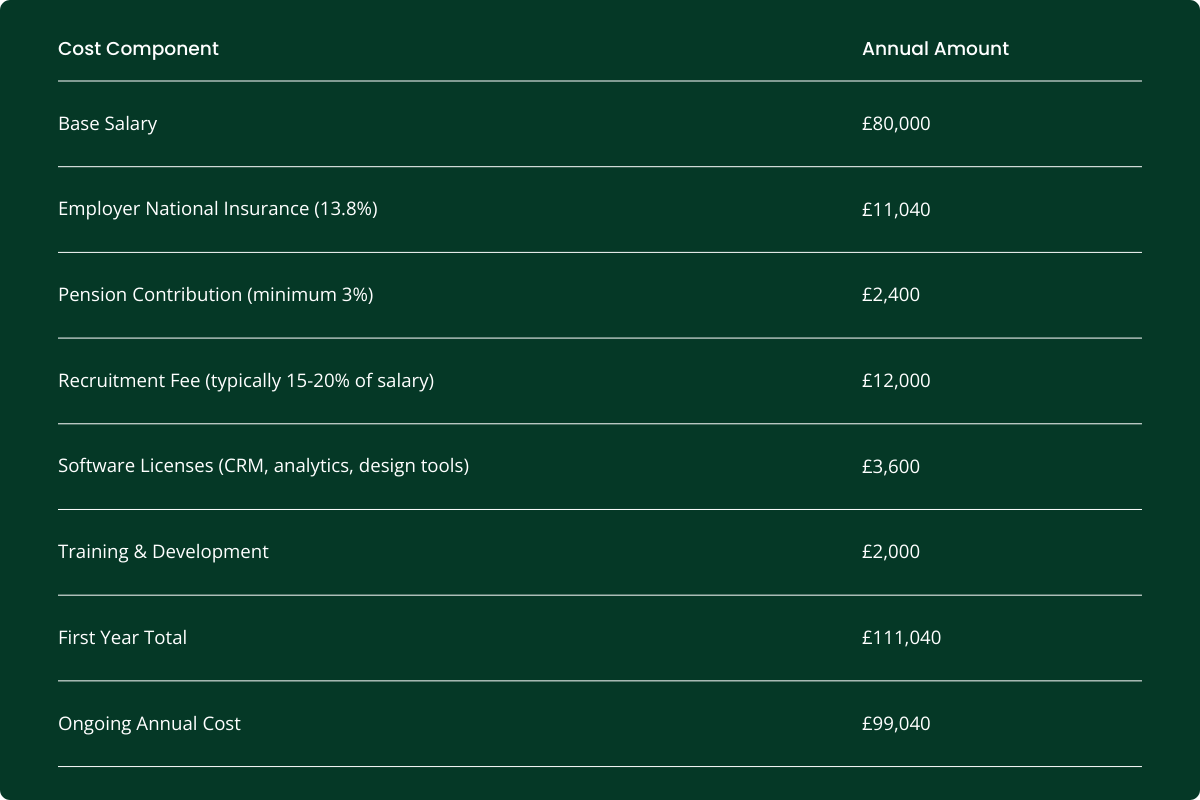
And that’s before you consider:
- Office space (if you’re not fully remote)
- Holiday cover (you’re down 28+ days per year)
- Sick leave
- The productivity dip while they’re learning your business
- The risk they’re simply not very good
But here’s the bigger problem: a Director shouldn’t be doing execution.
Their value is in strategy – understanding your market positioning, identifying growth opportunities, building a roadmap that aligns marketing with business objectives. That’s where an £80k salary makes sense.
What doesn’t make sense is paying £80k for someone to then spend 60% of their time writing blog posts, designing social graphics, or fiddling with Google Ads settings. That’s like hiring a surgeon to take your temperature.
The Fractional Marketing Team Model
Now let’s look at the alternative. With a fractional marketing team, you’re essentially getting:
- Strategic Direction – A Marketing Director who focuses purely on high-value work (your strategy, market positioning, campaign planning)
- Specialist Execution – Experts in SEO, Web Design, PPC, content creation, and social media who are brilliant at their specific discipline
- Accountability – A team that’s measured on results, not just activity
At Bite Marketing, our Fractional Marketing Team packages start from £2,000 per month. Here’s what that looks like compared to the in-house option:

The savings are striking. Even at the higher end of fractional engagement (£5,000/month), you’re spending 40% less than what an in-house director actually costs – whilst getting significantly more breadth of expertise.
Strategy vs. Execution: Why Directors Shouldn't Write Social Posts
Let’s be clear about what actually drives business growth. It’s not the volume of content you publish. It’s not how pretty your Instagram grid looks. It’s having a marketing strategy that’s aligned with your commercial objectives and executed by people who are genuinely good at their craft.
A Marketing Director’s brain should be focused on questions like:
- Which market segments offer the highest margin opportunities?
- Where should we allocate budget for maximum ROI?
- How do we position ourselves against larger competitors?
- What’s our content strategy for the next six months?
What a Director shouldn’t be doing:
- Spending two hours trying to remember how to edit a video
- Writing LinkedIn posts at 9pm because they ran out of time
- Teaching themselves Search Engine Optimisation through YouTube tutorials
- Designing graphics in Canva that would make a professional designer weep
With the fractional model, the Director does what they’re paid to do – think strategically. Then specialists execute brilliantly in their respective areas. Your SEO work is handled by someone who lives and breathes algorithm updates. Your Web Design projects are managed by developers who’ve built hundreds of sites. Your PPC campaigns are run by someone who’s spent millions of pounds of ad budget and knows what actually converts.
This isn’t just more efficient. It’s transformatively better quality.
The Proof: How This Model Delivers Real Growth
Theory is one thing. Results are another.
Take our work with Bandicoot, a Lancashire-based IT services company. When we started working with them, their Commercial Director Anna was trying to handle marketing herself whilst running the business. She was working on adrenaline, spreading herself impossibly thin, and genuinely stressed about whether their marketing efforts would ever gain traction.
As Anna told us: “The day Sam came along and presented our new strategy I went home early and went to bed. The adrenaline I’d been working on for months disappeared because I knew our marketing was in safe hands.”
We became their fractional marketing team. We developed a comprehensive marketing strategy, took over execution across multiple channels including social media, SEO, email marketing campaigns, and event support. Most importantly, we worked directly with their internal team without Anna having to be the middleman for every decision.
Over a year later, Bandicoot is getting exactly the type of clients they’re operationally geared up for, and they’re growing fast. The partnership has delivered improved search visibility and event success – all without the cost and risk of building an in-house team.
Similarly, when we worked with Lonsdale Health Products, a contract manufacturer specialising in nutraceuticals, they needed to reach strategic manufacturing contracts but their digital presence was virtually non-existent. Their state-of-the-art manufacturing capabilities and 40 years of expertise weren’t translating into online visibility.
We completely redesigned their website, created a professional digital presence, and launched targeted SEO and PPC campaigns specifically designed to reach businesses looking for a contract manufacturing partner. The result? A predictable sales pipeline that’s transformed their perspective on the potential of online marketing as a serious business development channel. As Andrew from Lonsdale told us: “We were sceptical about whether digital marketing would work for a niche business like ours, but Bite Marketing proved us wrong.”
These aren’t isolated success stories. They’re the natural outcome when you pair strategic direction with specialist execution, without the overheads that sink most in-house teams.
The Hidden Costs of Getting It Wrong
There’s one cost that rarely makes it into the spreadsheet: opportunity cost.
When you hire the wrong Marketing Director, you don’t just lose their salary for 12 months. You lose the growth you should have achieved. The leads that should have come in. The market position you should have claimed whilst your competitors were sleeping.
And here’s what makes it worse: most business owners don’t realise they’ve hired wrong until six or eight months in. By then you’ve spent £50,000+, your team is frustrated, and you’re back to square one with recruitment.
The fractional model dramatically reduces this risk. If the partnership isn’t working, you’re not locked into a 12-month commitment. You can adjust the scope, change direction, or part ways. That flexibility alone is worth a premium.
Stop Paying for Downtime
Here’s the brutal reality of in-house marketing: you’re paying full salary for part-time value.
Your Marketing Director is brilliant during campaign planning weeks. They’re earning their money when they’re presenting strategy to the board or negotiating with agencies. But what about the other 60% of their time? When they’re doing work that a £30k exec could handle? You’re paying £400 per day for someone to schedule tweets.
With a fractional marketing team, you only pay for the value you need. Director-level thinking for strategy. Specialist expertise for execution. Nothing wasted on the dead time in between.
Is the Fractional Model Right for Your Business?
This approach works brilliantly for ambitious B2B businesses that:
- Have turnover between £1 million and £10 million
- Understand marketing is essential but don’t need five full-time marketers
- Want strategic guidance without the overhead of a senior hire
- Value specialist expertise over generalist mediocrity
- Need flexibility as their business evolves
It’s particularly effective if:
- You’ve been burned by a previous marketing hire who promised the world
- Your current marketing feels scattergun rather than strategic
- You’re spending money on tactics without a coherent strategy
- You need someone to translate marketing jargon into commercial sense
Ready to Get the Marketing Leadership Your Business Deserves?
The choice isn’t really between in-house and fractional. It’s between marketing that’s a cost centre and marketing that’s a growth engine.
Stop paying for downtime. Stop hoping a unicorn will apply for your job ad. Stop cobbling together freelancers who never quite work as a team.
There’s a better way.
Book a free consultation and let’s discuss your current situation and goals. We’ll give you an honest assessment of whether the fractional model would work for your business – no hard sell, just straight answers.
Because the businesses that will win in 2026 aren’t the ones with the biggest marketing teams. They’re the ones with the smartest marketing strategy, executed brilliantly by specialists who know their craft.